Why 5-axis machining attracts attention
5-axis CNC machining is often presented as the premium solution for complex parts, but it is not automatically the best option for every project. In many cases, 3-axis or 4-axis machining can deliver the required result at a lower cost. The key question is not whether 5-axis machining is advanced, but whether it creates enough value for your part geometry, tolerance targets, and production plan.
What 5-axis CNC machining actually changes
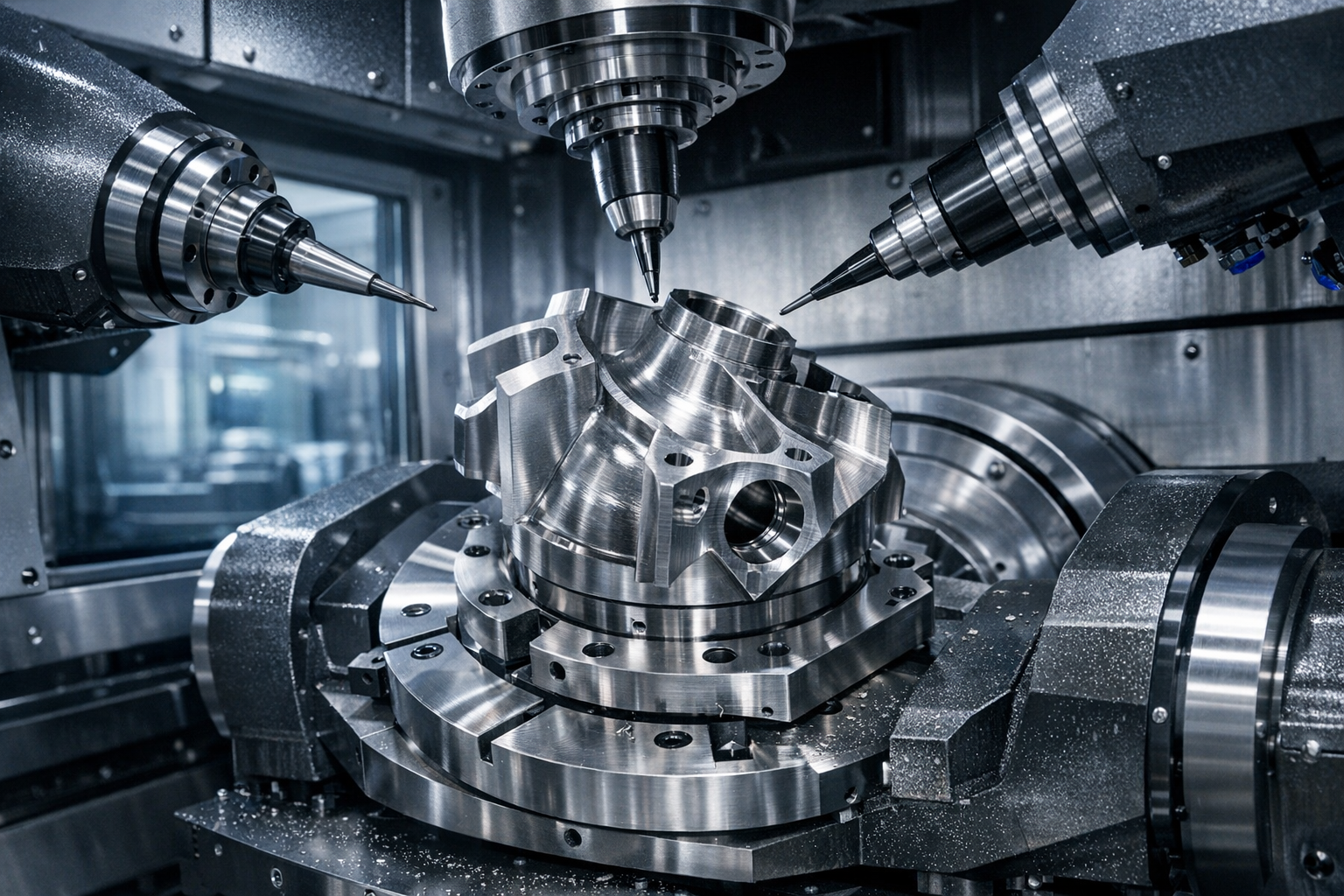
In 5-axis machining, the tool or part can move across five different axes, making it possible to machine complex surfaces and multiple faces with fewer setups. That reduces repositioning, improves access to difficult features, and can improve overall geometric accuracy on complex components.
- Better access to deep cavities and angled features
- Fewer setups for multi-face machining
- Potentially better positional accuracy between features
- Shorter total cycle time for complex parts
- Better surface finish on contoured geometry
When 5-axis machining is usually worth the extra cost
1. The part has complex geometry
If your component includes compound angles, curved surfaces, impellers, housings with multiple orientations, or difficult undercuts, 5-axis machining can reduce setup complexity and improve consistency.
2. Accuracy between multiple faces is critical
Every additional setup introduces a new opportunity for stack-up error. When several features on different faces must align precisely, 5-axis machining can improve accuracy by reducing repeated repositioning.
3. Surface finish matters on contoured features
For visible or functional curved surfaces, the ability to keep an optimal tool angle can improve finish quality and reduce the need for secondary polishing.
4. Setup reduction saves more than the machine rate adds
5-axis machine hourly rates are higher, but total part cost can still be lower if the process removes multiple fixtures, reduces manual intervention, and cuts inspection time.
When 5-axis machining may not be necessary
Not every part benefits from 5-axis processing. If the geometry is mostly prismatic and can be reached easily with standard fixturing, 3-axis or 4-axis machining may be more economical.
| Part condition | Best-fit process |
|---|---|
| Simple flat features on one or two faces | 3-axis machining |
| Indexed multi-face part with limited angular complexity | 4-axis or indexed setup |
| Complex surfaces and many angled features | 5-axis machining |
How to compare total cost correctly
Buyers often compare only machine hourly rate, but that misses the real picture. A better comparison includes:
- Programming complexity
- Fixture cost
- Number of setups
- Inspection time
- Scrap risk
- Surface finishing or manual rework
A more expensive machining method can still win when it lowers total process cost and delivery risk.
Questions to ask your CNC supplier
- Can this part be produced more efficiently with 3-axis, 4-axis, or 5-axis machining?
- How many setups are required under each option?
- Will 5-axis reduce fixture cost or improve positional accuracy?
- Does the geometry require simultaneous 5-axis movement or only indexed positioning?
- What is the impact on lead time and inspection?
Industries where 5-axis is especially valuable
5-axis machining is widely used in aerospace, medical devices, mold components, robotics, and high-performance industrial equipment because these parts often combine tight tolerances with complex geometry.
FAQ
Is 5-axis CNC machining always more accurate?
Not automatically. It can improve accuracy on complex parts by reducing setups, but for simple parts a well-controlled 3-axis process may be fully adequate.
Is 5-axis only for prototypes?
No. It can be used for both prototyping and production, especially where geometry complexity or setup reduction creates a strong cost advantage.
Can 5-axis lower cost?
Yes. Even with a higher hourly rate, fewer setups and less rework can reduce the total cost per part.
Conclusion
5-axis CNC machining is worth the extra cost when it solves a real manufacturing problem: complex geometry, tighter inter-feature accuracy, fewer setups, or better surface quality. The right decision comes from comparing total process cost, not just machine rate.